• BCSA Website
  • Roger Grund

South Australian
Butterflies & Moths

  • Home
  • Overview
    • Introduction
      • Key for Identifying SA Skippers
      • Key for Identifying SA Butterflies
    • Biology
    • Stories
      • Mistletoe
      • Caper White Migration
    • Butterfly Gardening
      • Common Urban Butterflies
      • Rarer Urban Butterflies
    • About Author
    • About Designer
  • Data Sheets
  • Conservation
    • Habitat Types
    • Habitat Restoration
      • Checklist
      • Details
    • Conservation Status
      • Checklist
      • Details
  • Food Plants
  • SA Regions
    • Adelaide Plains
    • Far North Pastoral
    • Flinders and Olary
    • Gawler Nullarbor
    • Kangaroo Island
    • Murray
    • North Mt. Lofty
    • South Mt. Lofty
    • Northern Eyre Peninsula
    • Southern Eyre Peninsula
    • Lower Southeast
    • Upper Southeast
    • Yorke
  • Sun-moths
    • South Australian Moths
    • About SA Sun-moths
    • Different Species
      • Nullarbor Sun Moth
      • Small Orange Spotted Sun Moth
      • Flinders Ranges Sun Moth
      • Kangaroo Island Sun Moth
      • Reddish-orange Sun Moth
      • Larissa's Sun Moth
      • Orange Sun Moth
      • Orange Spotted Sun Moth
      • Golden Sun Moth
      • Pale Sun Moth
      • Cryptic Sun Moth

Gallery

Catalog Wood White Gallery

Adults

aganippe_ad.jpg (39.8 KB)

Female from Port Gawler

aganippe_m4_Rush_Lagoon_KI.jpg (41.0 KB)

Male from Rush Lagoon, Kangaroo Island

aganippe_f2_6_Rush_Lagoon_KI.jpg (37.6 KB)

Female from Rush Lagoon, Kangaroo Island

aganippe_m5_4_Rush_Lagoon_KI.jpg (53.8 KB)

Male from Rush Lagoon, Kangaroo Island

aganippe_f3_4_Rush_Lagoon_KI.jpg (68.4 KB)

Female from Rush Lagoon, Kangaroo Island

Food Host

(Photo from http://users.sa.chariot.net.au/~rbg/)
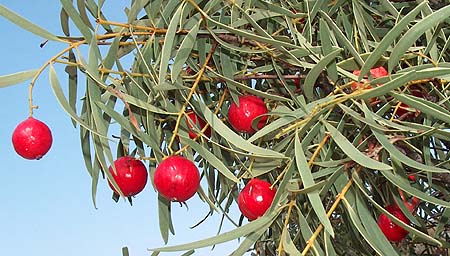
aganippe_quandong_Yalata.jpg (50.5 KB)

Red fruited (edible) Quandong tree (Santalum acuminatum), a larva foodplant of the Wood White.

Fruit are 25 mm in diameter

amyema_melaleucae_SYP.jpg (46.9 KB)

Red flowering Amyema melaleucae parasitising the Black Tea-tree (Melaleuca lanceolata) on Yorke Peninsula.

The mistletoe parasitises mainly M. lanceolata but also sometimes M. halmaturorum (Swamp Paperbark).

amyema_melaleucae2_SYP.jpg (54.7 KB)

Closeup of Amyema melaleucae. The mistletoe is a preferred larva foodplant in coastal areas for the Wood White and also the Amaryllis Azure (Ogyris amaryllis).

amyema_preissii.jpg (60.5 KB)
amyema_preissii2.jpg (52.6 KB)

The red flowering Wire-leaf Mistletoe (Amyema preissii). It usually parasitises Acacia.

Amyema_pendula_LSE.jpg (71.5 KB)

Amyema pendula (orange-green leaf clumps), parasitising Eucalyptus baxteri in the Lower Southeast Region.

Amyema_miquelii_BH.jpg (71.1 KB)

Red flowering Amyema miquelii parasitising Eucalyptus, an important larva foodplant for the Wood White in woodland areas.

Acacia_papyrocarpa.jpg (50.3)

Grey Mistletoe (Amyema quandong) parasitising a Western Myall tree (Acacia papyrocarpa).

Mistletoe_Aquandang_Bot.jpg (49.5 KB)

Closeup of Amyema quandong. It is an important larva foodplant for the Wood White in inland areas.

Eggs

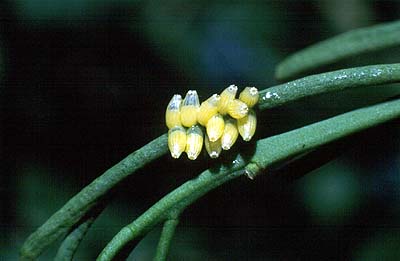
aganippe_eg.jpg (18.5 KB)

Small egg batch on foodplant Amyema preissii

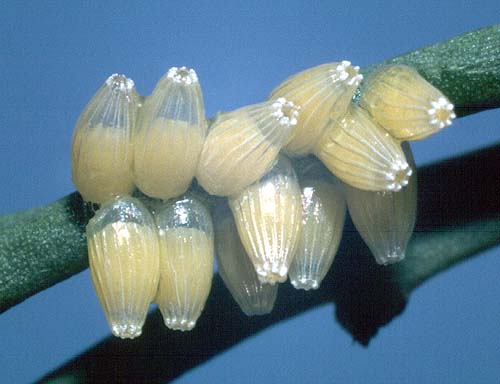
aganippe_eg2.jpg (29.6 KB)

Closeup of above egg batch

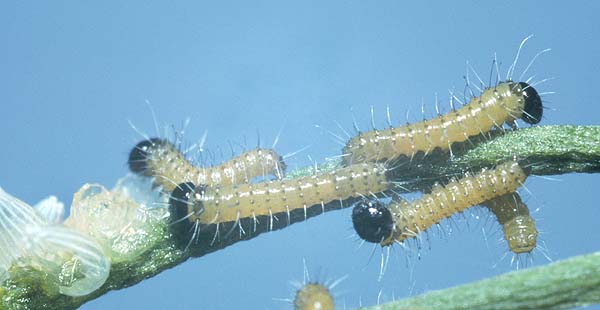
aganippe_la_1st_early.jpg (29.6 KB)

Newly emerged first instar larvae

aganippe_la_1st_early_setae.jpg (26.6 KB)

Poison tipped glandular setae on first instar larva

Larvae

aganippe_la_5th.jpg (41.8 KB)

Photography by R. Fisher

Gregarious mature larvae of the Wood White feeding on mistletoe

aganippe_la2_5th.jpg (35.7 KB)

Photography by R. Fisher

Mature larva
of the Wood White

Pupae

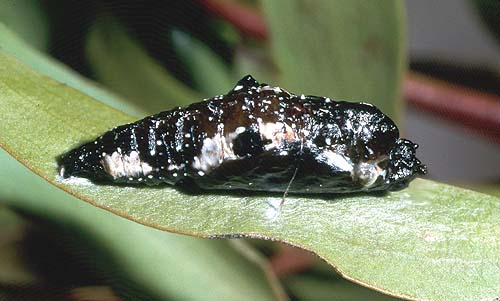
aganippe_pu.jpg (35.0 KB)

Photography by R. Fisher

Pupa of the Wood White

All photography by R. Grund unless stated otherwise.